AI adoption
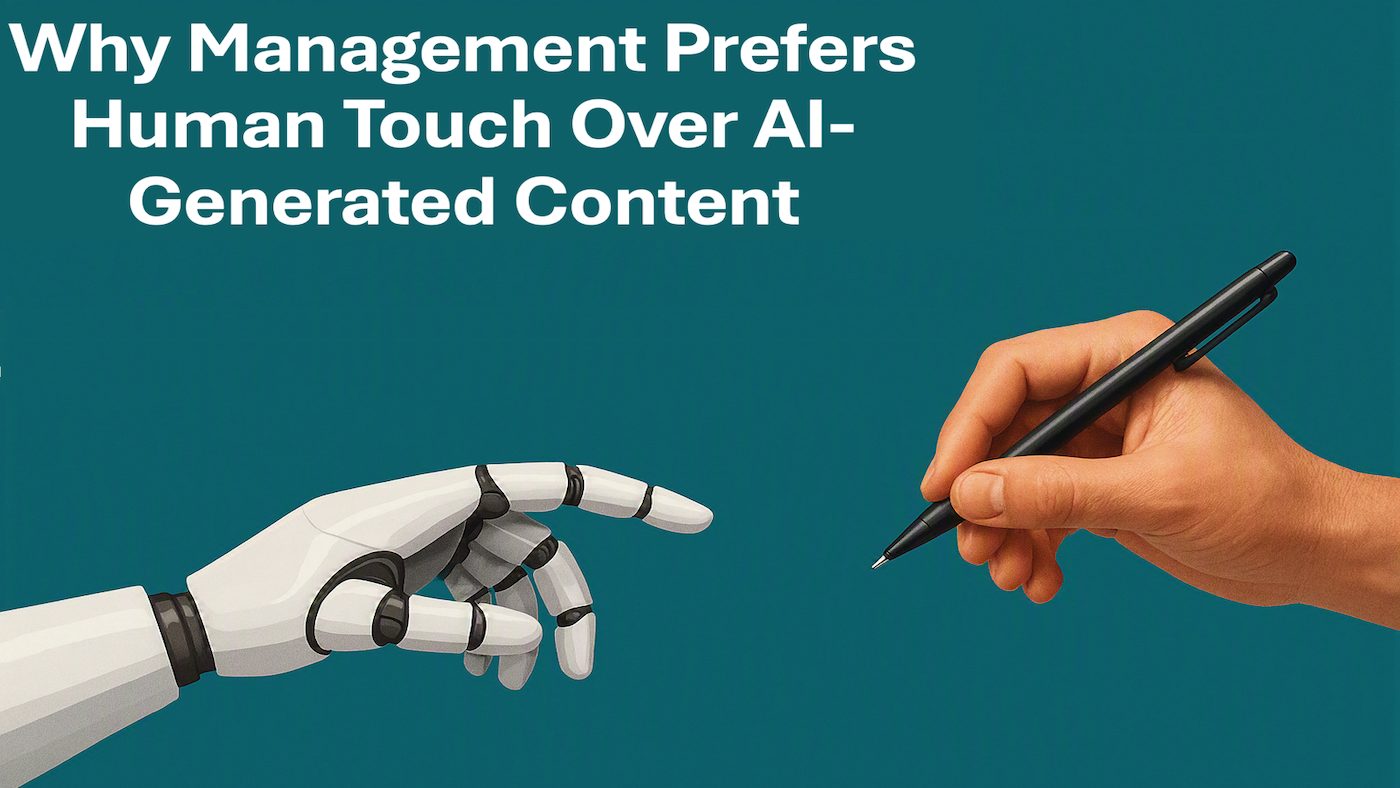
Why Management Prefers Human Touch Over AI-Generated Content — And What We’re Missing
AI is everywhere today.
From meeting notes to million-dollar proposals, from marketing campaigns to corporate decks—AI has compressed days of work into minutes. What used to take:
- 30 minutes is now instant (MoMs)
- 1–2 days is now under an hour (RFP analysis)
- 2–3 days is now 30 minutes (presentations)
- 1 week is now a few prompts (marketing content)
- 1 month is now a day (videos, audio promos)
And yet...
Senior management resists AI-generated output. Universities restrict it. Customers distrust it. Even colleagues hesitate to read it.
This contradiction is worth exploring.
The Paradox: Efficiency vs Acceptance
Let’s acknowledge reality:
AI is not replacing work. AI is replacing effort.
And that’s exactly where the discomfort begins.
Because in professional environments, effort has always been a proxy for value.
When something that once took days is delivered in minutes, the natural reaction is:
“Was enough thinking done?”
Why Leadership Distrusts AI-Generated Content
1. Lack of Ownership
AI-generated content often feels... orphaned.
There’s no visible thinking trail, no scars of iteration, no human struggle behind it.
Management doesn’t just want output. They want accountability for the thinking behind the output.
2. Uniformity Kills Differentiation
AI tends to produce:
- Structurally perfect
- Grammatically clean
- Contextually safe
But also:
- Predictable
- Generic
- Lacking strong point of view
For leadership, especially in sales, strategy, and positioning:
“Different wins deals. Generic loses them.”
3. Trust Deficit in High-Stakes Communication
Customers can sense templated responses:
- RFP submissions feel reused
- Presentations lack contextual sharpness
- Proposals feel “assembled,” not crafted
When money, risk, and reputation are involved, human intent matters more than written perfection.
4. AI Removes “Thinking Friction” — and That’s Dangerous
Earlier, effort forced clarity:
- Writing MoMs = understanding discussion deeply
- Reviewing RFPs = discovering hidden risks
- Building decks = shaping narrative logic
AI skips this friction.
And leadership fears:
Are we becoming faster... but less thoughtful?
5. Cultural Conditioning: Effort = Credibility
Executives grew up in systems where:
- Hard work = long hours
- Quality = time invested
AI disrupts that equation.
And until a new credibility system is accepted, quick output will be subconsciously undervalued.
Why Universities Resist AI (But Corporates Shouldn’t)
University resistance is logical.
They are building:
- Analytical thinking
- Problem-solving ability
- Cognitive independence
AI can short-circuit all three.
But corporates?
They are solving:
- Speed
- Scale
- Efficiency
- Competitive execution
Avoiding AI here is not prudence— it’s a missed advantage.
So Where Should Professionals Actually Use AI?
The mistake is simple:
Professionals are using AI for output. They should be using AI for acceleration.
Here’s the shift.
Best Use of AI (High Acceptance)
1. Pre-Work Acceleration
- RFP summarization
- Competitive analysis
- Research synthesis
Human still owns final judgment.
2. First Draft Generation
- Deck outlines
- Proposal structures
- MoM templates
Human adds narrative, context, and emphasis.
3. Thought Organization
- Converting rough ideas into structured flow
- Extracting insights from meetings/transcripts
AI becomes a thinking partner, not a replacement.
4. Productivity Multipliers
- Email polishing
- Content repurposing
- Quick visual drafts
AI reduces operational load, not intellectual ownership.
Where AI Fails (and Gets Rejected)
- Final client proposals submitted “as is”
- Leadership presentations without personalization
- Thought leadership without original insight
- Strategy decks lacking real-world nuance
This is where management resistance is justified.
The Real Issue: AI vs Human is the Wrong Debate
The real divide is:
Unedited AI Output vs Human-Augmented Intelligence
AI alone feels hollow. Human-only effort is slow.
But together?
That’s where exponential value is created.
The Winning Model: Human Signature + AI Acceleration
The professionals who win in the AI era will follow this formula:
AI does
- Speed
- Structure
- Summarization
Humans add
- Judgment
- Context
- Experience
- Storytelling
- Risk awareness
Final Thought
Management doesn’t hate AI.
They hate:
- Lack of thinking
- Lack of ownership
- Lack of originality
AI is not the problem.
Unsupervised AI is.
Call to Action
As professionals, we shouldn’t ask:
“Can AI do this for me?”
Instead, ask:
“How can AI help me think better, move faster, and deliver sharper?”
Because in the end:
AI will not replace professionals. But professionals who use AI well will replace those who don’t.
Article in collaboration with Microsoft Copilot