AI adoption
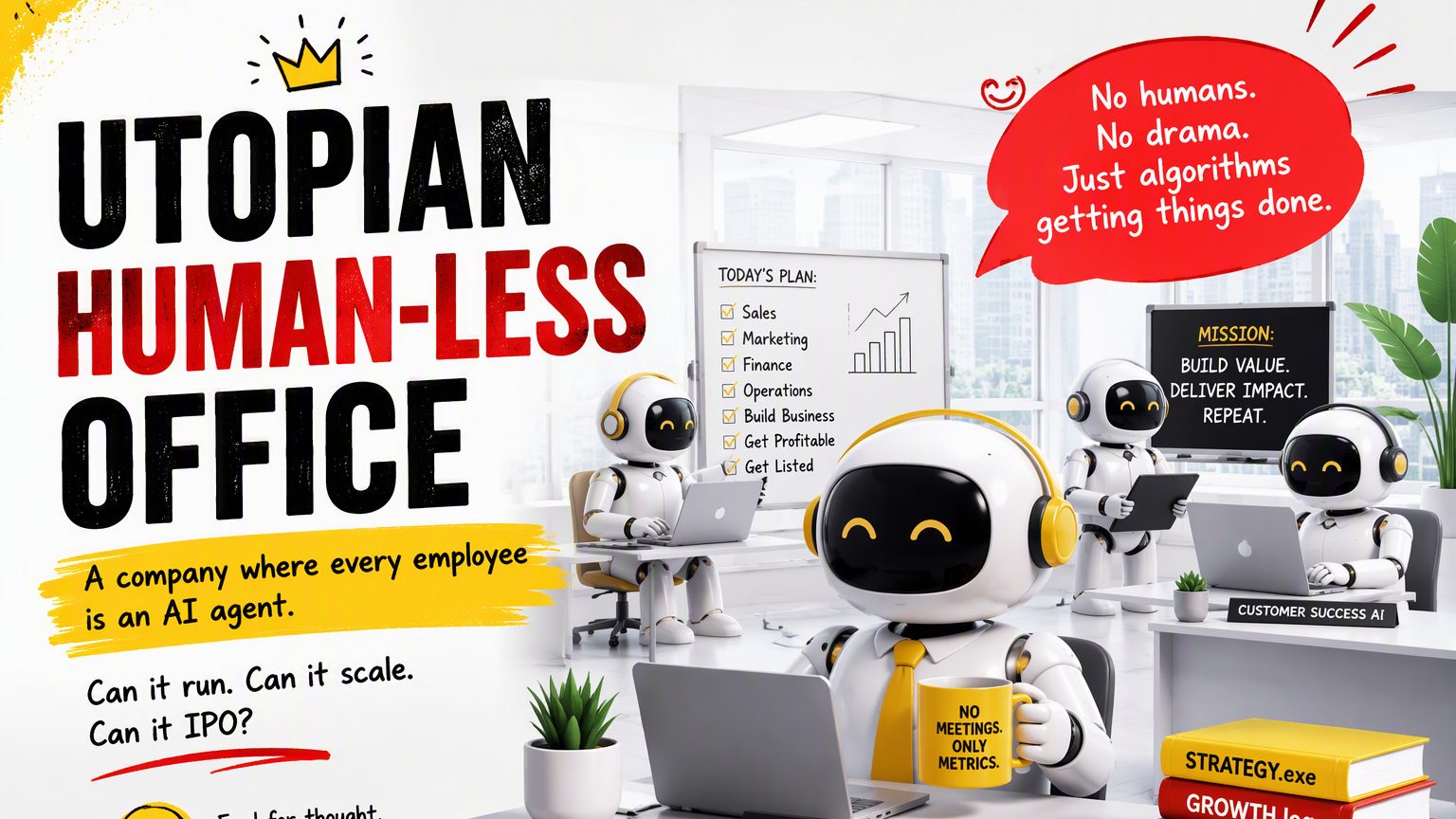
Could a company run without a single employee?
Every business in history has depended on people.
From ancient trading houses to modern global enterprises, humans have sold products, negotiated deals, built technology, managed operations, made decisions, and taken responsibility when things went wrong.
But imagine removing people from the operating model entirely.
Not reducing headcount. Not automating a department.
Removing every human role.
An AI CEO defines strategy. AI sales agents prospect leads, conduct meetings, and negotiate pricing. Marketing agents create campaigns, launch them, analyze results, and adjust budgets. Finance agents close the books. Legal agents review contracts. Engineering agents build products. Customer-support agents resolve issues. HR agents recruit and deploy new AI agents.
The company never sleeps. It operates around the clock, scales almost instantly, and doesn't face many of the constraints that shape human organizations today.
A decade ago, that idea sounded far-fetched. Today, it feels like a logical extension of technologies that already exist.
AI systems can research markets, write content, generate software, analyze financial performance, handle customer inquiries, coordinate workflows, and interact with other AI systems.
Individually, those capabilities solve specific problems. Connected together, they start to resemble entire business functions.
The challenge is no longer task execution. It's organizational ownership.
Businesses are more than collections of activities. They are collections of responsibilities.
If an autonomous company signs a contract, who is legally bound by it? If fraud occurs, who is accountable? Who appears before regulators? Who owns the intellectual property created by autonomous systems?
Current legal and regulatory frameworks assume that a person or a group of people ultimately stands behind every corporate action.
That creates an interesting tension. An AI-driven company may be capable of performing the work, yet society still expects humans to bear the consequences.
Now extend the idea further.
What happens when the customer is also represented by AI?
A vendor's sales organization is staffed by agents. The buyer's procurement team is staffed by agents. Pricing is negotiated algorithmically. Contracts are reviewed automatically. Payments are approved by software. In some cases, the product itself may be consumed by software systems.
Large parts of commerce could occur without a single human conversation.
Humans would still own assets, set goals, and receive returns, but many day-to-day transactions could happen between machines acting on behalf of people.
That possibility points to a different role for humans inside organizations.
Instead of spending most of their time executing work, people may increasingly focus on defining the boundaries within which work is executed.
They set the purpose of the company. They define its values. They decide how much risk is acceptable. They establish objectives and constraints.
Within those boundaries, AI systems handle execution.
If that future arrives, the biggest obstacle may not be technology.
The harder question is whether customers, governments, investors, and society are comfortable with organizations that have no humans in their operating structure.
The technological path is becoming easier to imagine.
The legal, social, and philosophical path is far less clear.
And that may be the debate that ultimately determines how autonomous companies can become.