AI FinOps
The AI Cost Problem Nobody Talks About: Why AI FinOps Must Become a Boardroom Discussion
Artificial Intelligence has moved beyond experimentation.
Across industries, organizations are deploying AI assistants, copilots, intelligent agents, retrieval systems, automated workflows, and generative AI applications at an unprecedented pace. While most discussions focus on innovation, productivity, and transformation, a critical question is often overlooked:
Who is managing the economics of AI?
Many organizations can tell you:
- Which AI models they use
- How many users have access
- Which business functions are experimenting with AI
Far fewer can answer:
- What is the actual cost per business outcome?
- Which AI workloads deliver measurable value?
- How much is spent on inference, fine-tuning, infrastructure, and governance?
- Where are the biggest optimization opportunities?
- What is the return on AI investment?
As AI adoption scales, these questions become strategic, not operational.
Cloud FinOps Was Just the Beginning
A decade ago, organizations faced similar challenges with cloud computing.
Development teams could provision resources in minutes, creating incredible agility but often leading to uncontrolled spending. This gave rise to Cloud FinOps—a discipline that brought together finance, technology, and business teams to improve visibility, accountability, and cost optimization.
Today, AI is creating a comparable challenge.
Unlike traditional cloud workloads, AI introduces additional layers of complexity:
- Token-based pricing
- Multiple model providers
- Agent orchestration costs
- GPU-intensive workloads
- Embedding and vector database expenses
- Prompt engineering inefficiencies
- Governance and compliance overhead
Without a structured approach, organizations may find themselves scaling AI usage without understanding the true economic impact.
AI Spending Without Governance Is Unsustainable
Many enterprises are currently focused on proving AI use cases.
However, the next phase will be different.
Executive leadership will increasingly ask:
- Which AI projects should we scale?
- Which ones should we optimize?
- Which ones should we stop funding?
- What business value have we generated from AI investments?
The organizations that cannot answer these questions with confidence will struggle to sustain AI programs over the long term.
This is where AI FinOps becomes essential.
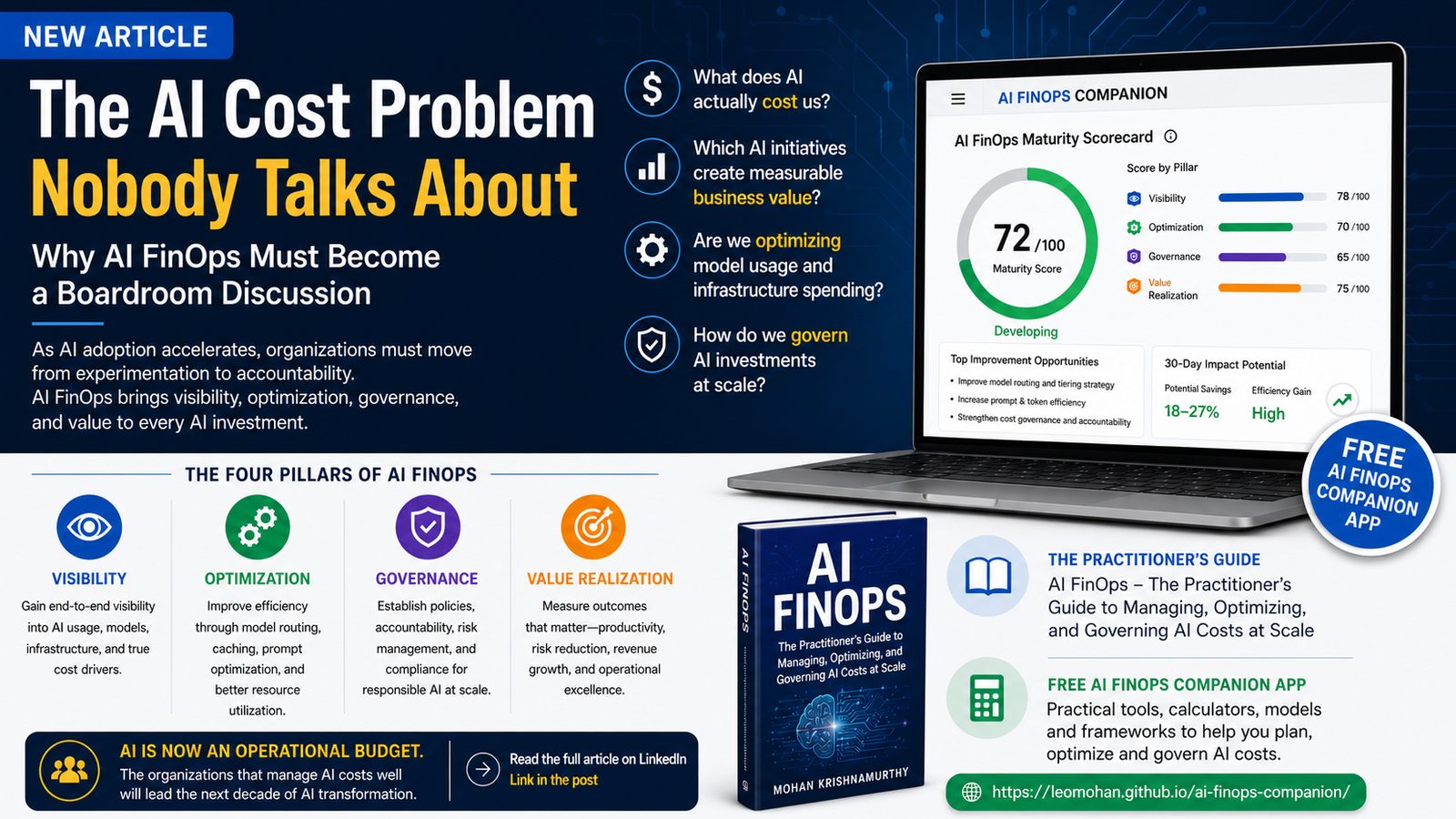
The Four Pillars of AI FinOps
In my view, a practical AI FinOps program must focus on four key areas:
1. Visibility
You cannot optimize what you cannot see.
Organizations need clear visibility into:
- AI consumption
- Model utilization
- Infrastructure costs
- Unit economics
- Cost drivers across business functions
2. Optimization
Every AI workload contains opportunities for improvement.
These include:
- Model routing strategies
- Caching mechanisms
- Prompt optimization
- Batch processing
- Workload scheduling
- Resource utilization improvements
Small efficiencies at scale can translate into significant cost savings.
3. Governance
As AI usage expands, governance becomes increasingly important.
Organizations need policies for:
- Model selection
- Cost accountability
- Responsible AI usage
- Risk management
- Vendor management
- Compliance requirements
4. Value Realization
Ultimately, AI should not be measured solely by technology metrics.
It should be assessed based on:
- Business outcomes
- Productivity gains
- Risk reduction
- Customer experience improvements
- Revenue growth
- Operational efficiency
The objective is not simply reducing AI costs.
The objective is maximizing business value from AI investments.
AI FinOps Is Not About Spending Less
A common misconception is that FinOps is primarily about cost reduction.
In reality, the goal is smarter investment.
There are situations where spending more on AI delivers exponentially greater business value.
The challenge is ensuring that every dollar invested contributes to measurable outcomes.
Organizations that master AI FinOps will gain a significant advantage because they will be able to scale AI initiatives with confidence, predictability, and accountability.
Final Thoughts
AI is rapidly becoming an operational budget category rather than an innovation budget category.
The organizations that establish visibility, optimization, governance, and accountability today will be better positioned to scale AI successfully tomorrow.
To help practitioners build and operationalize AI FinOps capabilities, I recently published:
AI FinOps – The Practitioner's Guide to Managing, Optimizing, and Governing AI Costs at Scale
And to make these concepts immediately actionable, I have also created a free companion application featuring:
- AI cost calculators
- Token economics models
- Infrastructure cost estimators
- Model routing analysis
- Unit economics frameworks
- AI FinOps maturity assessments
- Optimization tracking tools
Book: https://www.amazon.in/dp/B0GX5LQPLW
Free AI FinOps Companion App: https://leomohan.github.io/ai-finops-companion/
Article in association with Microsoft Copilot