Post-quantum
Why BFSI Leaders in the Middle East Must Act on Post-Quantum Cryptography (PQC) Now—Not Later
For years, quantum computing was viewed as a distant possibility—something researchers and governments would worry about while enterprises focused on today's cybersecurity challenges.
That perception is rapidly changing.
Across the global financial sector, regulators, central banks, cybersecurity agencies, and technology leaders are preparing for a future where quantum computers can break the public key cryptography that underpins today's digital trust ecosystem.
The question is no longer:
"Will quantum computing impact cybersecurity?"
The real question is:
"Is your organization preparing early enough to avoid becoming tomorrow's cryptographic liability?"
Understanding the Real Threat: Harvest Now, Decrypt Later
Most banking executives assume that quantum risk becomes relevant only when large-scale quantum computers arrive.
Unfortunately, cybercriminals don't operate that way.
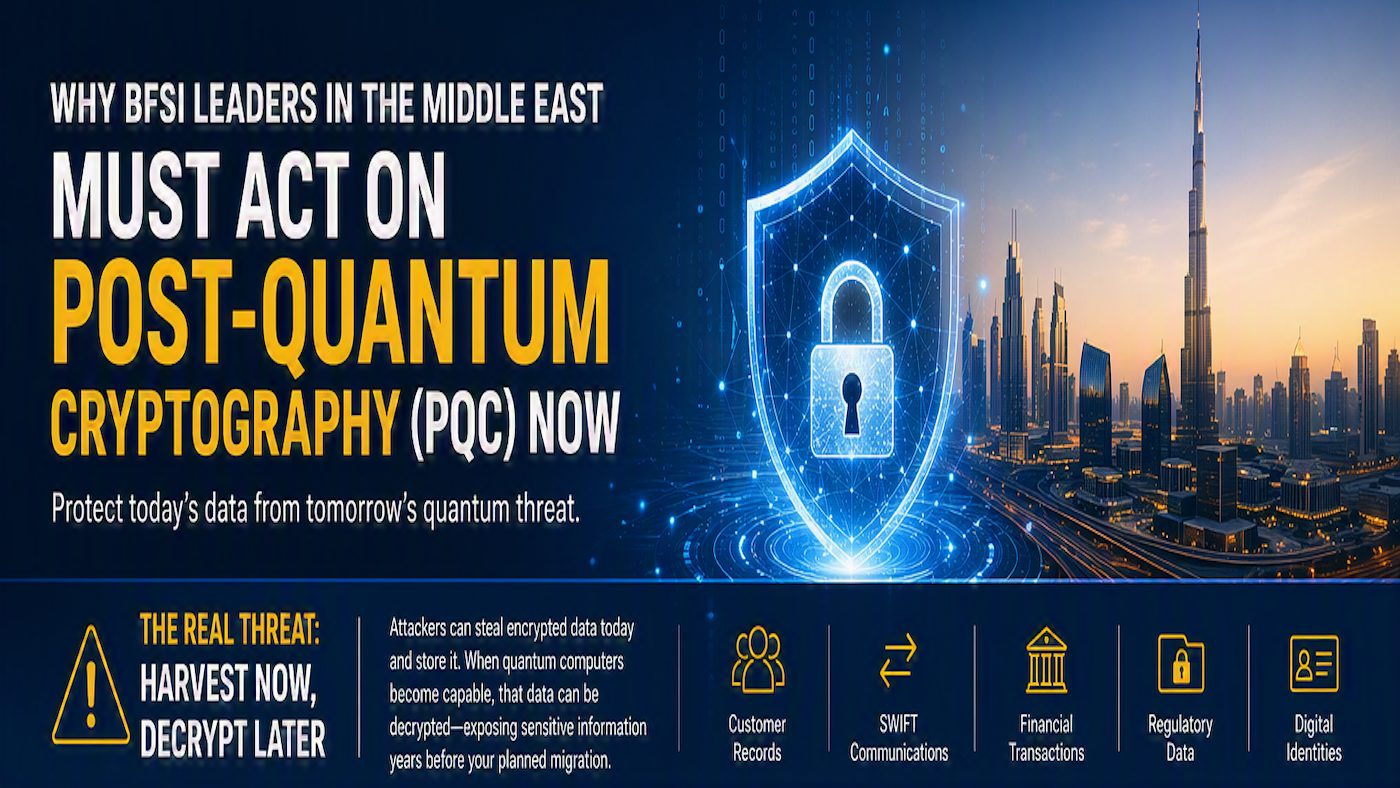
A growing concern is the Harvest Now, Decrypt Later (HNDL) attack model:
- Attackers steal encrypted data today.
- The data may remain unreadable for years.
- Once quantum computing becomes capable of breaking traditional cryptography, that stored data can be decrypted.
This creates a critical risk for organizations that manage long-retention data, including:
- Customer banking records
- SWIFT communications
- Wealth management data
- Corporate banking information
- Digital identities
- Financial transactions
- Regulatory submissions
- Personally Identifiable Information (PII)
For BFSI institutions, data confidentiality requirements often extend well beyond 10 years.
The concern is not just protecting tomorrow's transactions. It is protecting today's data from future exposure.
The Hidden Cryptographic Challenge Inside Most Banks
During discussions with financial institutions across the GCC, I often ask three questions:
- Do you have a complete inventory of all certificates across your environment?
- Can you identify every application dependent on RSA or ECC cryptography?
- If your regulator requested a Post-Quantum Cryptography migration roadmap tomorrow, could you provide one?
In most cases, the challenge is not migration.
The challenge is visibility.
Large banks typically operate thousands—sometimes tens of thousands—of cryptographic assets across:
- Internet banking platforms
- Mobile banking applications
- APIs
- Core banking systems
- SWIFT infrastructure
- VPN environments
- Identity platforms
- DevOps pipelines
- Cloud workloads
- Containers and Kubernetes
- Databases
- HSMs
- Internal applications
Many organizations do not possess a centralized view of these assets.
And what you cannot see, you cannot secure.
Why BFSI Organizations Should Start Preparing Today
A successful PQC journey is not about replacing certificates overnight.
In reality, the transition will take years.
The institutions that succeed will start with preparation, assessment, and crypto-agility—not technology replacement.
Key Risk Areas Financial Institutions Must Address
1. Cryptographic Asset Visibility
Organizations need a complete inventory of:
- Certificates
- Keys
- Certificate Authorities
- Trust Stores
- TLS Endpoints
- Signing Systems
Without visibility, migration planning becomes impossible.
2. Legacy Algorithm Dependency
Many critical banking systems still depend heavily on:
- RSA-2048
- RSA-4096
- ECC
Understanding where these dependencies exist is the foundation of a successful PQC strategy.
3. Certificate Lifecycle Management
Manual certificate management introduces:
- Expiry risks
- Operational outages
- Compliance concerns
- Weak cryptographic governance
Automation and centralized visibility will become increasingly important.
4. Long-Term Data Protection
Financial institutions must evaluate:
- Sensitive data repositories
- Data-at-rest protection
- Encryption key management
- HSM integration
- Long-retention data policies
This is where HNDL risks become most relevant.
5. Crypto Agility
Perhaps the most important capability of all.
Organizations must build environments capable of adapting quickly to evolving cryptographic standards without major disruptions.
The future belongs to institutions that can change cryptographic algorithms as easily as they update software.
What a Practical PQC Readiness Journey Looks Like
Rather than pursuing a risky "big bang" migration, leading organizations are adopting a phased approach:
Phase 1: Discover
Identify:
- Certificates
- Keys
- Algorithms
- Trust relationships
- Cryptographic dependencies
Outcome: Complete visibility.
Phase 2: Assess
Evaluate:
- Quantum exposure
- Migration complexity
- Business criticality
- Long-term confidentiality risks
Outcome: PQC Readiness Assessment.
Phase 3: Prioritize
Focus first on:
- Customer-facing platforms
- Identity systems
- Critical applications
- Payment and transaction systems
Outcome: Risk-based roadmap.
Phase 4: Hybrid Deployment
Move from:
Legacy Cryptography → Hybrid Cryptography → Quantum-Safe Cryptography
This minimizes operational disruption while maintaining business continuity.
How Evanssion and Nexus Can Help
At Evanssion, we work closely with IN Groupe Nexus, a global leader in digital identity, PKI, and certificate lifecycle management.
Nexus supports governments, central banks, and large enterprises worldwide and provides capabilities that help organizations:
- Discover and inventory cryptographic assets
- Assess quantum readiness
- Establish centralized certificate governance
- Automate certificate lifecycle management
- Enable crypto-agility
- Implement hybrid cryptographic strategies
- Prepare for full PQC adoption
Most importantly, the focus is not to sell another security product.
The objective is to help organizations answer a much more important question:
"Are we ready for the quantum era?"
Final Thoughts
The biggest cybersecurity failures rarely happen because organizations ignored a threat.
They happen because organizations waited too long to act.
Post-Quantum Cryptography is no longer a research topic.
It is becoming a boardroom discussion, a regulatory discussion, and increasingly, a business continuity discussion.
The banking institutions that begin their readiness journey today will have the flexibility, visibility, and resilience needed to navigate the transition.
The institutions that delay may find themselves racing against regulatory timelines and technological realities.
The quantum era is approaching.
The time to prepare is now.
I'd be happy to connect with CISOs, CIOs, Heads of Infrastructure, Enterprise Architects, and Digital Trust leaders across the GCC to discuss practical approaches to Post-Quantum Cryptography readiness.
Article in association with Microsoft Copilot