Governance and compliance
Why AI Governance Must Come Before AI Platforms in the Enterprise
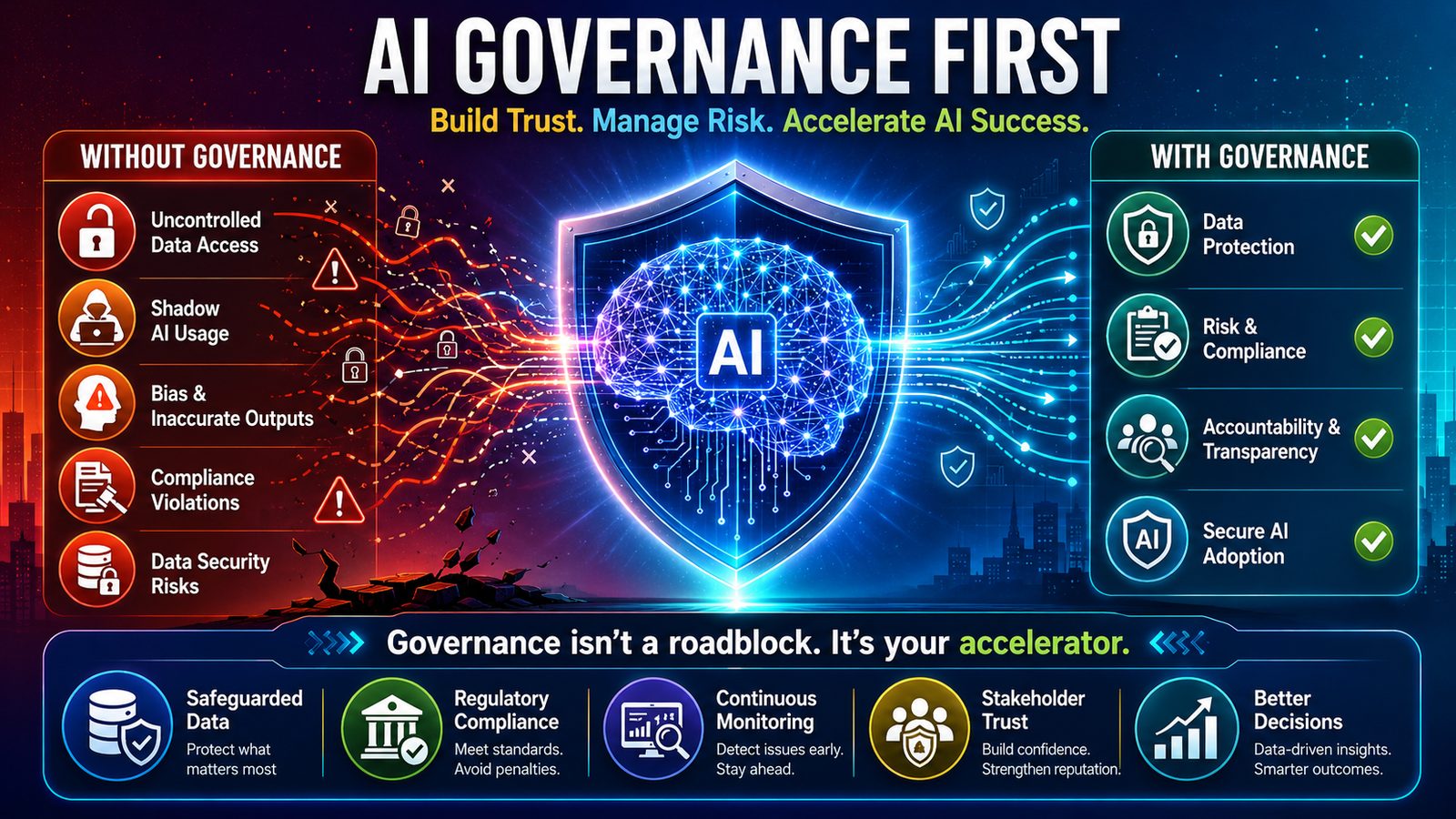
You wouldn’t build highways and then decide the traffic rules— AI is no different: governance must come first, or scale becomes risk.
As enterprises across the world accelerate their AI adoption journeys, a familiar pattern is emerging: “Let’s pick a platform, run a pilot, and then scale.”
While this approach may work for traditional technologies, AI is fundamentally different. And that difference makes one thing critically important:
AI Governance must come before AI deployment.
The Hidden Risk: Building AI Without Guardrails
Many organizations are already experimenting with LLMs, copilots, and automation tools—often through business units or innovation teams.
But without governance:
- Sensitive data is exposed unintentionally
- Models produce unverified or biased outputs
- Compliance violations go unnoticed
- Shadow AI usage spreads across teams
What starts as “innovation” can quickly become enterprise risk at scale.
AI Is Not Just Another IT Project
Unlike traditional software:
- AI systems learn and evolve over time
- Outputs are probabilistic, not deterministic
- Decisions may impact customers, regulators, and reputation
- Data becomes the most critical control point
This means AI requires a different foundation—one that blends:
- Cybersecurity
- Data governance
- Risk management
- Regulatory awareness
- Ethical frameworks
What Does AI Governance Actually Mean?
AI governance is not bureaucracy—it’s enablement with control.
A strong governance framework defines:
1. Data Boundaries
- What data can be used in AI systems?
- What must never leave the enterprise?
- How is PII protected?
2. Model Accountability
- Who owns the model?
- How are outputs validated?
- How are errors handled?
3. Access & Usage Policies
- Who can use AI tools?
- For what purposes?
- Under what controls?
4. Compliance & Risk Alignment
- Alignment with regulations
- Auditability of AI decisions
- Third-party AI vendor risk management
The Platform Trap
Many enterprises jump straight into:
- ChatGPT-style deployments
- AI copilots
- API-based integrations
- Industry AI tools
But without governance, these become:
- Data leakage channels
- Uncontrolled decision engines
- Compliance liabilities
Technology alone does not create value—controlled usage does.
AI Governance as a Business Accelerator
Contrary to perception, governance does not slow down AI adoption.
It actually accelerates it by:
- Building stakeholder confidence (CXO, legal, compliance)
- Enabling safe scaling across departments
- Reducing rework and failed pilots
- Creating a clear roadmap for AI investments
Enterprises that get this right move from experimentation → production → scale much faster.
A Practical Starting Point
Before choosing any AI platform, enterprises should establish:
- AI Usage Policy (what is allowed vs restricted)
- Data Classification for AI readiness
- Vendor & Model Risk Assessment framework
- AI Security & Monitoring baseline
- Cross-functional AI governance team
Only then should the conversation shift to:
“Which AI tools and platforms should we deploy?”
Final Thought
AI is not just a technology shift—it is a decision-making shift.
And when decisions are augmented by machines, governance becomes non-negotiable.
Organizations that lead in AI will not be the ones who adopt first— but the ones who adopt responsibly, securely, and at scale.
Article in association with Microsoft Copilot