Software business
Vibe Coding vs. Building a Real Software Business
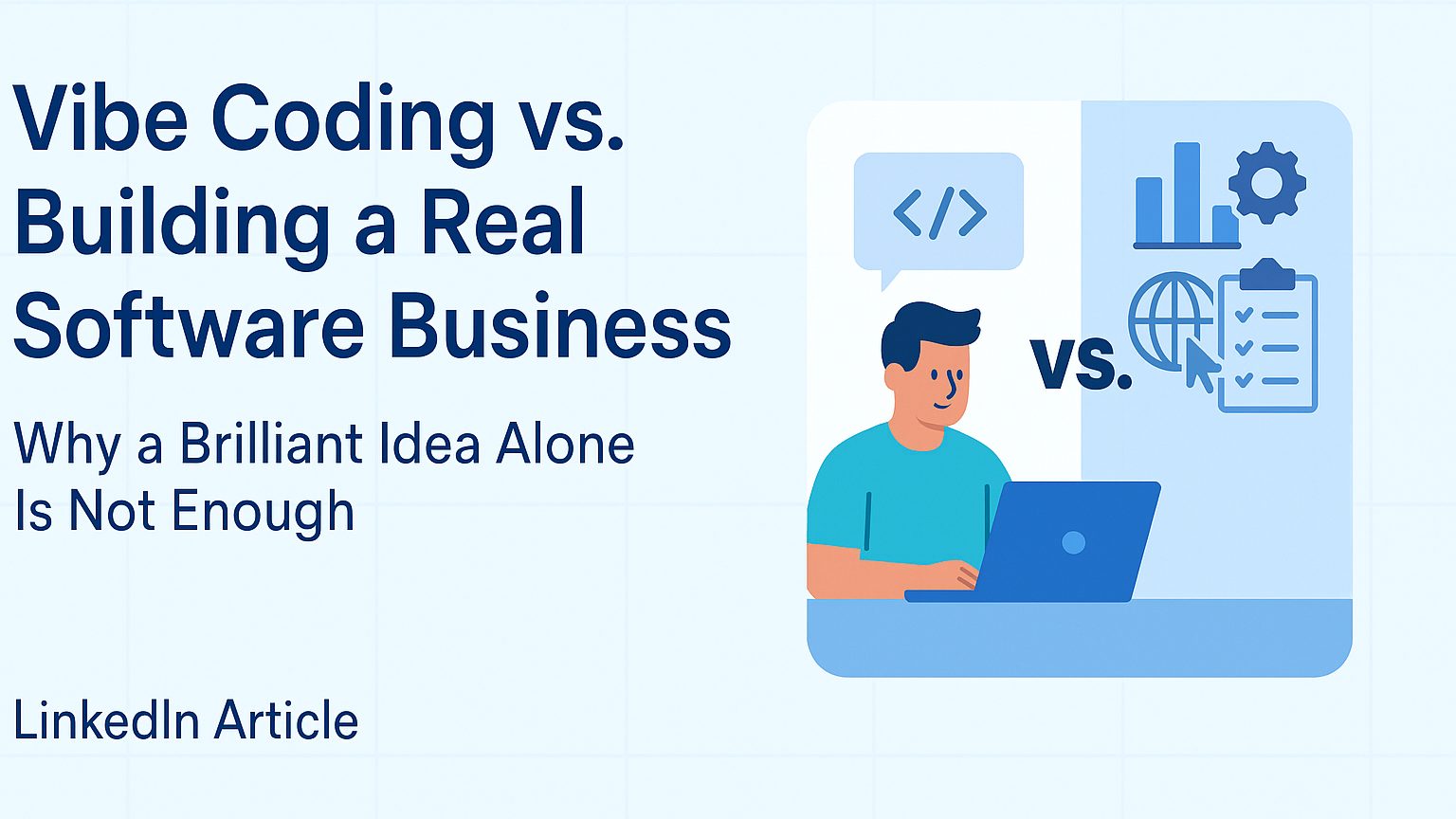
There’s a growing belief in today’s tech culture that one brilliant idea + fast coding = a successful software company. This mindset, often glorified as “vibe coding”, assumes that if you can quickly build something that works, the business will somehow take care of itself.
That assumption is not just optimistic—it’s dangerously incomplete.
Let’s be clear:
- Not all software sells.
- Not all software that sells today will continue to sell tomorrow.
- And selling software—especially to enterprises—is hard.
Software Is Not Just Code. It’s a Business.
Building software and building a sustainable software business are two very different things.
An application that works for a few users—or even a few thousand users—does not automatically qualify as an enterprise-grade product. Enterprises don’t buy ideas. They buy outcomes, assurance, and continuity.
An enterprise-ready software product must be:
- Secure by design, not “secured later”
- Continuously tested for vulnerabilities
- Built with compliance in mind from Day One
If your product is hosted in the cloud, customers will inevitably ask:
- Are you SOC 1 compliant?
- Are you SOC 2 compliant?
- How do you handle data privacy?
- What is your incident response plan?
A great demo won’t answer these questions. Governance will.
Cloning a Popular Product ≠ Building a Business
The market is full of clones—some technically impressive, some cheaper, some “faster built.”
But cloning a popular product does not guarantee:
- Market trust
- Customer loyalty
- Long-term revenue
- Or survival when competition intensifies
Without a clear differentiation, roadmap, and execution capability, the product eventually stalls.
Ideas are fragile. Businesses must be resilient.
What Actually Makes Software Sustainable?
Sustainable software companies are built on far more than developers and code repositories. They require a functioning organization, including:
- Sales – understanding how buyers think and buy
- Presales – translating features into business value
- Marketing – positioning, messaging, and trust-building
- HR – hiring, retention, and succession planning
- Finance & Accounts – cash flow, pricing, compliance
- Operations – delivery, uptime, and customer success
A product without these functions is not a company—it’s a project.
Taking a Product Global Is a Different Game
The moment you think beyond a local or niche market, complexity multiplies.
Going country-level or global requires:
- A solid distribution network
- Local or regional partner ecosystems
- Understanding regional customer expectations
- Local compliance and regulatory awareness
- Strong, clear documentation
- Training programs for partners and customers
- A professional website and knowledge base
- FAQs that reduce dependency on individuals
- A real support community
- Support infrastructure, including a ticketing system
- Well-defined plans for upgrades, updates, patches and end-of-life policies
Enterprises don’t just evaluate your product. They evaluate your ability to support it for years.
The Single-Point-of-Failure Problem
Here’s the uncomfortable question many early products ignore:
What happens if the one person who “knows everything” leaves?
If your product:
- Exists only in one person’s head
- Cannot be maintained without a specific individual
- Has undocumented workflows
- Has unclear backup and restore mechanisms
- Has undefined high-availability architecture
- Has vague guarantees around data integrity and security
Then it is not enterprise-ready—no matter how elegant the code looks.
Enterprises don’t buy brilliance. They buy predictability and continuity.
Where Vibe Coding Actually Fits
To be clear, vibe coding is not bad.
It is excellent for:
- Personal projects
- Prototypes
- MVPs
- Internal tools for small teams
- One-off applications for limited use cases
It encourages creativity, speed, and experimentation.
But vibe coding alone cannot carry:
- Enterprise customers
- Regulatory obligations
- Long-term SLAs
- Global scale operations
At that point, creativity must be supported by structure.
Before Taking Your Product to Market, Ask Yourself
Before you commit to monetizing or scaling your product, pause and ask:
- Do I have a genuinely unique idea, or just a faster clone?
- Do I have a long-term roadmap, not just a feature list?
- Do I have the investment capacity to scale nationally or globally?
- Do I truly understand enterprise customer needs?
- Can the company continue to develop, support, and sell the product if one or two key developers leave?
- Is the product defendable—not just buildable?
If the answer to these questions is unclear, the risk is not technical. It’s existential.
Final Thought
Vibe coding can create amazing software. But only disciplined execution creates enduring businesses.
If your ambition is to serve enterprises, operate globally, and build something that lasts, the product must be backed by:
- Governance
- Security
- Process
- People
- And a real business engine
Code starts the journey. Organization sustains it.
Article in collaboration with Microsoft Copilot