Security operations
A Look at an Enterprise Cybersecurity Scenario: Before and After AI
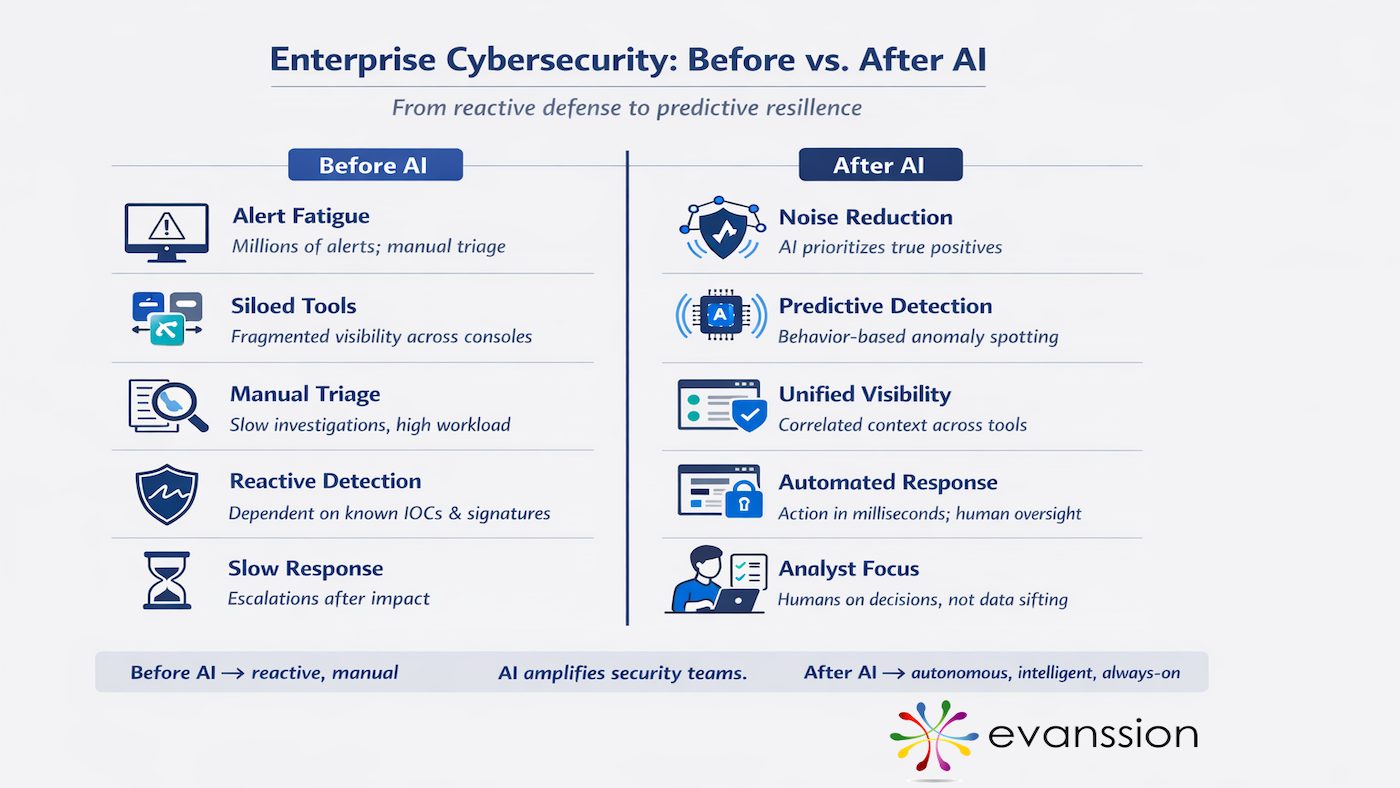
Cybersecurity leaders today sit at an inflection point. For decades, enterprise security architectures have been shaped by a combination of tools, processes, and human expertise—strong, but fundamentally limited by manual detection, slow investigation cycles, and reactive decision-making. Now, AI is re-wiring this landscape.
Below is a simple yet powerful way to visualize this transformation: a “before and after AI” scenario that captures how enterprise security actually changes when AI becomes deeply embedded in operations.
Before AI: A World of Manual Defenses
1. Alert Fatigue and Slow Triage
Security Operations Centers (SOCs) receive thousands—sometimes millions—of alerts daily. Analysts manually sift through logs, endpoints, network data, and cloud telemetry.
- High mean time to detect (MTTD)
- Analysts spending 70%+ of their time on triage
- Missed threats buried in noise
2. Siloed Security Tools
Enterprises deploy 60–80+ security tools on average. These tools don’t talk to each other, forcing analysts to jump across consoles to reconstruct an incident.
- Fragmented visibility
- High operational overhead
- Slow investigations
3. Reactive Security Posture
Threat detection depends heavily on:
- Known signatures
- Known vulnerabilities
- Human-driven hunting
Unknown attacks—zero-days, supply chain compromises, insider threats—often go unnoticed until damage occurs.
4. Skill Shortages
Security teams are always understaffed. Talent scarcity reduces depth of analysis and increases human error.
This was the cybersecurity world for years: hardworking teams, good tools, but too much complexity and too little time.
After AI: Autonomous, Adaptive, Always-On Security
1. AI Reduces 90% of Manual Noise
Modern AI models ingest petabytes of telemetry—network flows, logs, identities, API traffic, and cloud data—correlating it in seconds.
- Real-time threat scoring
- Context-aware alerts
- Automated triage
Analysts focus on decisions, not detection.
2. Threat Detection Moves from Reactive to Predictive
AI learns behavior, not signatures. It finds weak signals that humans can’t see:
- Subtle lateral movement
- Impossible travel patterns
- API abuse anomalies
- Identity misuse patterns
This is proactive cybersecurity—not waiting for an IOC to appear.
3. Autonomous Incident Response
AI can now:
- Quarantine compromised endpoints
- Block malicious API calls
- Disable risky user accounts
- Enforce micro-segmentation policies
All within milliseconds.
Humans remain in control, but machines take the first action.
4. Deep Visibility Without Tool Sprawl
AI acting as a unifying layer integrates and interprets data from every security tool. This delivers:
- A single correlated incident timeline
- Context-rich insights
- Faster decision-making
The SOC becomes an intelligence center, not an alert center.
5. Augmented Analysts; Not Replaced Analysts
AI automates repetitive tasks, accelerates investigations, strengthens decision-making, and up-skills junior analysts. The result:
- Faster ramp-up
- Higher accuracy
- Lower burnout
Human judgment + machine speed becomes the winning combination.
A Simple Example: A Credential Compromise Attack
Before AI
- Suspicious login occurs at 2 AM.
- Alert generated but buried in a queue of hundreds.
- Analyst reviews logs manually 6–8 hours later.
- Lateral movement goes unnoticed.
- Data exfiltration occurs.
- Incident escalates only after a large impact.
After AI
- AI detects abnormal login based on behavior patterns.
- Contextual correlation reveals unusual access attempts.
- AI automatically challenges authentication or locks the account.
- Analyst receives a summarized root-cause report.
- No data exfiltration occurs.
An attack that used to take hours to spot is now resolved in seconds.
Final Thought: AI Isn’t the Future—It’s the New Baseline
Enterprises that embrace AI in cybersecurity aren’t just improving efficiency—they are fundamentally shifting from reactive defense to predictive resilience.
The organizations that win in the next decade will be those that:
- Automate the bottom 80% of SOC operations
- Use AI-driven analytics as their foundation
- Focus humans on strategy, not manual work
AI doesn’t replace the cybersecurity professional. It amplifies them.
This is the new enterprise reality. And the transformation has already begun.