Cyber readiness
December Holiday Season & Cyber Risk: Why the Pressure Rises
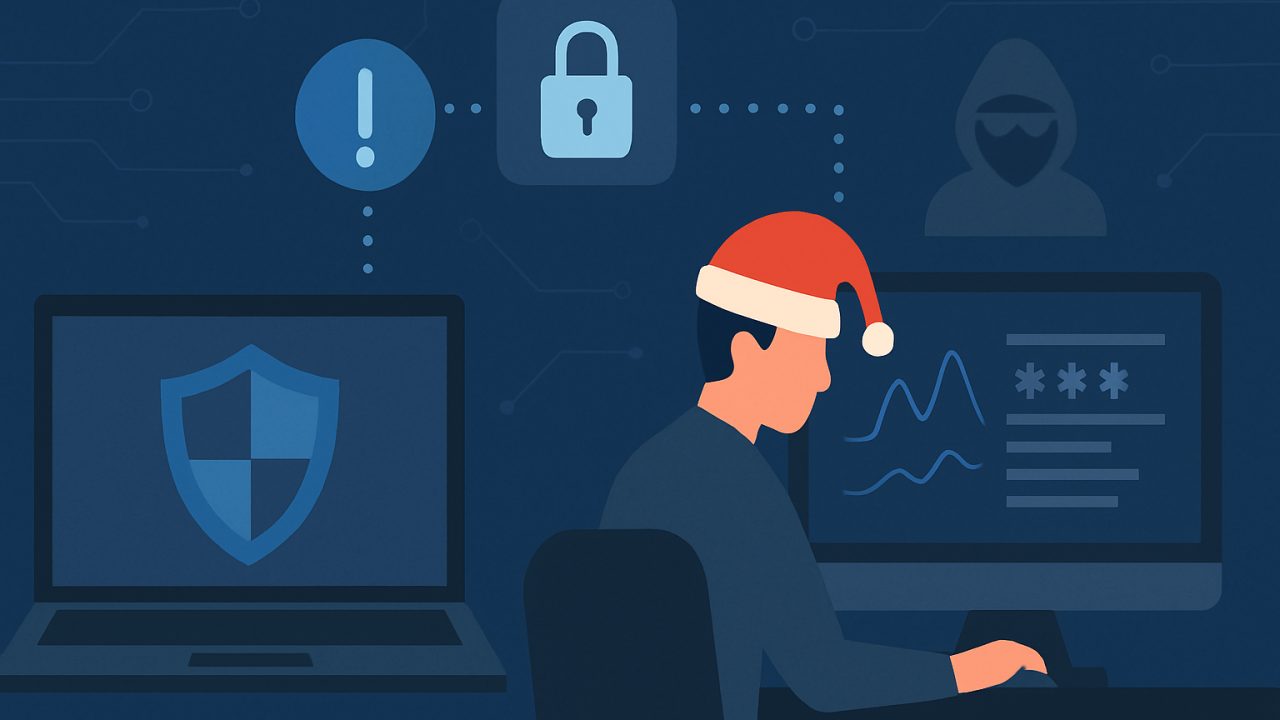
As December approaches and organisations wind down for year-end holidays — vacations, family time, lighter staffing — cyber attackers ramp up their activity. Multiple studies show that cyberattacks, especially ransomware and phishing, increase by ~ 30% during holiday periods.
Here’s why:
- Reduced vigilance & skeleton staffing: Many security teams scale down operations, or operate with minimal staff. That creates blind spots — fewer eyes to catch suspicious login attempts, anomalous traffic, or malware activity.
- Heightened distraction & social engineering opportunities: Employees are often distracted — wrapping up year-end work, finalising holiday plans, shopping for gifts. Such distraction increases the chance that phishing emails, courier scams (fake delivery notifications), or “holiday sale” tricks slip through.
- Spike in digital activity — shopping, payments, third-party interactions: The surge in e-commerce, orders and payments around the holidays offers more chances for attackers to launch scams, fake-site frauds or payment-info theft.
- Attackers know you’re less ready: Many organisations delay patches, postpones audits, or leave updates for after the holidays — leaving exploitable vulnerabilities open.
In short: while staffs are winding down, attackers are just warming up.
What Organisations Should Do Before Employees Head Off for Holidays
To avoid a holiday-season cyber fiasco, organisations — especially those in cybersecurity, system integration or any enterprise providing critical services — should take a proactive, “holiday-ready” posture.
Here’s a practical checklist:
Pre-holiday security audit & patching
- Ensure all systems, endpoints, servers, network devices are updated with the latest patches. Vulnerabilities exploited by attackers often remain unpatched during holiday downtime.
- Review configuration, check for open ports, unused remote-access channels, outdated software versions, obsolete permissions.
Backup & recovery readiness
- Take a full offline backup (or immutable backup) of critical data before the holiday begins. As some security providers stress — assume that “data-recovery capabilities are paramount over the holiday season”.
- Validate your backup restore procedures. If a ransomware or ransomware-adjacent attack occurs during holidays, being able to restore quickly can make the difference between a minor hiccup and a full-blown outage.
Implement/freeze access controls & acceptable-use policies
- Enforce stricter access controls: Limit employee ability to install new software, connect unknown devices, or access risky categories of websites (e.g. dubious downloads, personal file-sharing, suspicious external links).
- Put in place a “holiday mode” — i.e., reduce exposed attack surfaces, disable non-essential remote access, restrict admin privileges to minimal necessary roles.
Security awareness & “holiday-special” staff training
- Run a short refresher or awareness session before holidays: highlight typical holiday-season phishing/social-engineering scams (fake parcel notifications, “urgent” emails about missed deadlines or account issues, fake sales/gift-card scams).
- Encourage a “Stop-Think-Verify” culture: Before clicking links, opening attachments, entering credentials, especially in holiday-themed messages.
24/7 Monitoring & On-call Response Plan
- Even if many employees are off, ensure a skeleton SOC (Security Operations Center) remains on monitoring duty — or outsource to a trusted partner if needed. Evidence shows that organisations reducing staff during holidays face longer detection and response times, and greater impact.
- Prepare and document an Incident Response Plan tailored for holiday periods: Who to contact, communication channels, backup restore procedures, escalation process, external vendor contacts, etc.
Limit non-business/low-value traffic & third-party risk before closure
- Freeze new third-party software installs or vendor integrations close to holidays unless absolutely essential. Each integration or code push adds risk.
- Evaluate any lingering supply-chain dependencies — e.g., if you use external software/tools — ensure their patches/updates are in place before taking leave.
Reflections for Sales & Cybersecurity Leaders (Especially in System-Integration / MSP Context)
For sales leaders and managers at cybersecurity and system-integration firms:
- Position proactive security readiness as a value-add to clients. Many organisations undervalue the “holiday vulnerability window.” Use this period as a differentiator — offer pre-holiday audits, holiday-mode hardening, on-call backup coverage as part of your service.
- Use real incidents (even from global context) to educate clients. Share anonymized case-studies (or aggregate data) about how ransomware & phishing spike during holidays to emphasize the cost of neglect.
- Design holiday-specific packages — e.g. “Year-end hardening + backup + 24/7 SOC for 2 weeks” — could be attractive for businesses going offline or scaling down.
- Promote security awareness internally & in clients’ organisations — during festive seasons, employees are more likely to let guard down. A quick refresher, even if just a few slides or an email, can reduce human-error risk significantly.
Final Thought: Don’t Let Holiday Cheer Blindside Your Security
The holiday season should be a time for celebrations, rest, and personal time — not for cleaning up after a cyber-incident. Yet attackers know that this is the single best time to strike: because defences are down, vigilance is low, and organisations are moving slowly.
By preparing in advance — auditing, patching, backing up, restricting access, ensuring monitoring, and training staff — you can dramatically reduce the risk, and make sure that when December bells ring, they don’t signal a breach.
Let this year’s holiday season be about joy, not regrets.
Happy Holidays!
Article in association with OpenAI ChatGPT