AI reliability
AI Systems Don’t Crash — They Drift. And That Changes Everything.
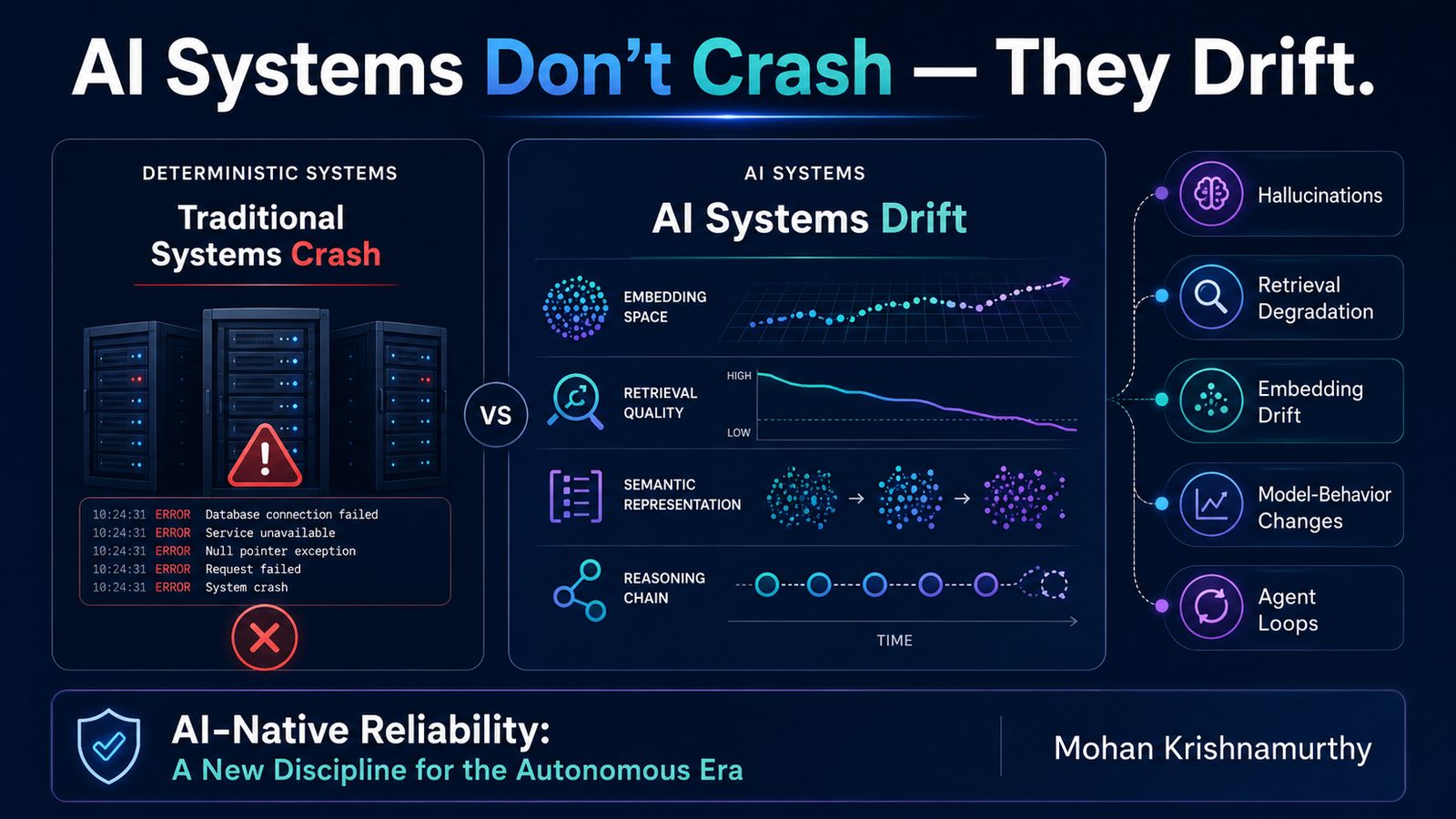
Over the last 18 months, enterprises have discovered a hard truth: AI systems don’t fail the way traditional software fails.
They don’t throw exceptions. They don’t trigger alerts. They don’t produce stack traces.
Instead, they behave differently.
They drift. They hallucinate. They mis-retrieve. They mis-route. They loop. They silently degrade.
And because these failures are semantic, not mechanical, they slip past every monitoring tool we’ve built over the last 20 years.
This is why the industry is now facing a reliability gap — not in infrastructure, but in intelligence.
We’re entering the era of AI-Native Reliability
As organizations deploy LLMs, RAG pipelines, and autonomous agents into customer-facing and mission-critical workflows, they’re discovering new operational realities:
- A single embedding model update can break retrieval.
- A vendor model swap can change reasoning style overnight.
- A safety filter regression can block legitimate content.
- A mis-routed agent can burn thousands of dollars in minutes.
- A subtle drift in behavior can erode trust long before anyone notices.
These are not SRE problems. These are AI-SRE problems.
AI-SRE is not “AI for SRE.” It’s SRE for AI.
This distinction matters.
Most tools in the market today focus on AI-powered SRE — using AI to reduce alert noise, detect anomalies, or automate runbooks.
But what enterprises urgently need is the opposite:
A discipline that makes AI systems themselves reliable.
A discipline that understands:
- prompts as code
- embeddings as memory
- retrieval as cognition
- reasoning as execution
- agents as autonomous actors
A discipline that treats hallucinations as outages, drift as degradation, and safety as a first-class reliability concern.
This is the foundation of a new product line we’re building — one that brings structure, governance, and operational excellence to AI systems.
Why this matters now
AI is moving from experimentation to production. From copilots to agents. From assistance to autonomy.
And with autonomy comes responsibility.
Enterprises need a way to ensure that AI systems remain:
- trustworthy
- predictable
- safe
- cost-efficient
- compliant
- self-healing
This requires new metrics, new observability layers, new incident-response models, and new architectural patterns — none of which exist in traditional SRE or MLOps.
A new discipline is emerging
Over the coming weeks, I’ll be sharing insights from a new body of work that defines this discipline:
- AI-native failure modes
- AI observability stacks
- AI-driven incident detection
- Self-healing architectures
- RAG reliability engineering
- Agent safety and control planes
- AI-SRE governance models
- Zero-touch reliability
This is not a framework. It’s not a methodology. It’s a new operational foundation for the AI era.
If you’re building or deploying AI systems at scale, this is the conversation you’ll want to be part of.
AI-SRE is coming — and it will redefine how enterprises operate intelligent systems.