Security operations
AI-Powered SOC (a.k.a. “Autonomous SOC”): From Reactive Noise to Proactive Defense
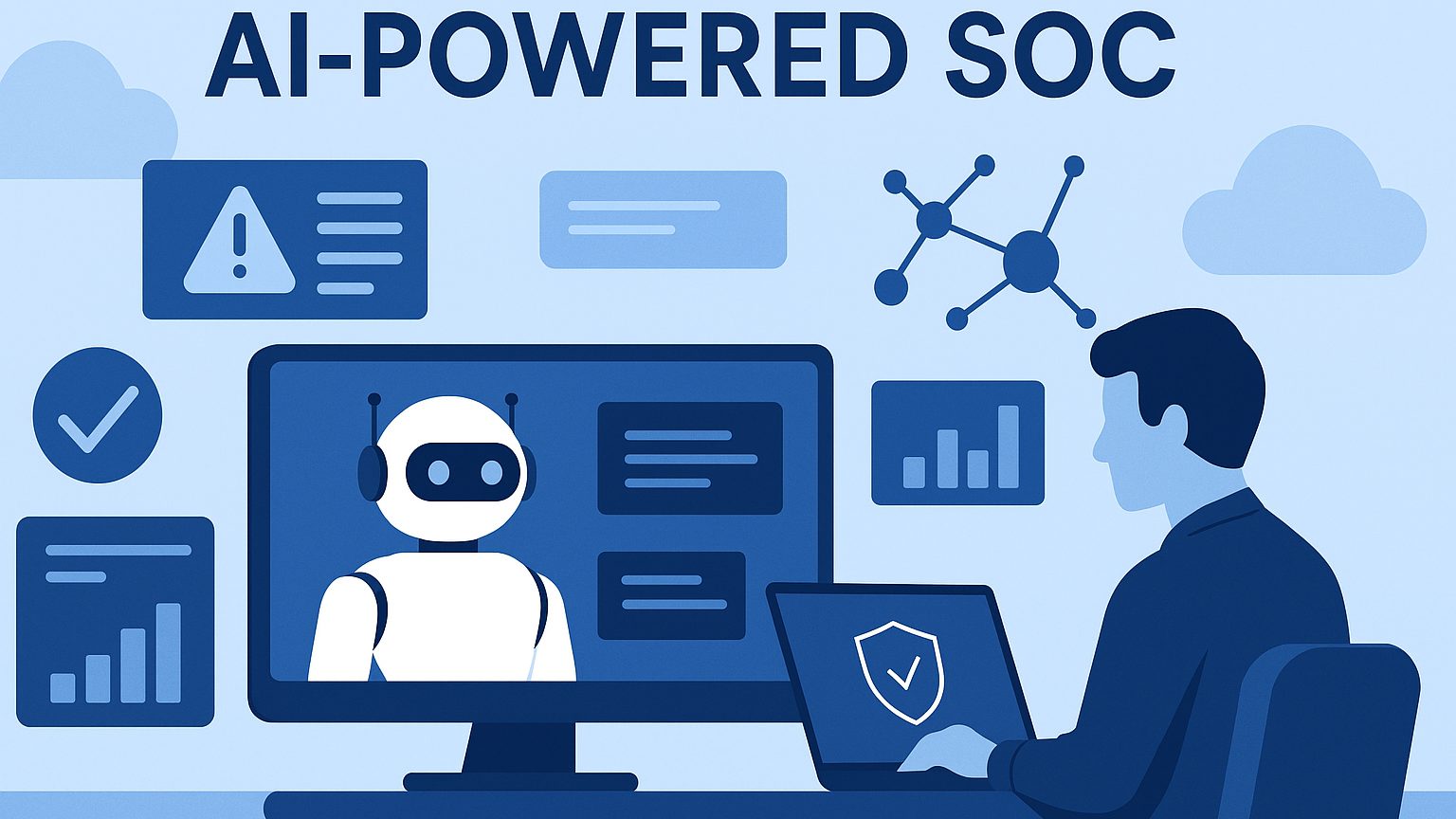
Security operations centers (SOCs) are under pressure like never before: more data, more alerts, more tooling, and a stubborn talent shortage. Recent industry studies show alert fatigue and analyst burnout remain pervasive; many teams still spend more time maintaining tools than defending the organization, and a significant portion of alerts go uninvestigated.
Against this backdrop, the AI-powered SOC—often described as an autonomous SOC—has emerged as a pragmatic path to scale, speed, and resilience. Think less “robots replacing humans” and more agentic AI that handles repetitive investigations so analysts can focus on high-impact decisions.
What is an AI-Powered / Autonomous SOC?
At its core, an AI-powered SOC augments the full security operations lifecycle—detection, triage, investigation, response, and reporting—with machine learning, generative AI, and specialized agents. These systems correlate signals across SIEM, endpoint, network, cloud, identity, and threat intel; they prioritize what matters; and, within governed guardrails, they execute routine actions and document everything for audit. Humans remain the final authority.
“Autonomous SOC” doesn’t mean “no humans.” It means high-volume, low-complexity tasks can be automated, while humans steer novel, complex investigations and strategy. Done right, autonomy sits inside transparent guardrails (explanations, evidence trails, approvals).
How It Differs from the Current State of SOC
Most SOCs today rely on static detections, manual investigations, and siloed tools. Automation exists, but it’s often brittle (playbooks that require constant tuning) and limited to enrichment or ticketing. By contrast, an AI-powered SOC introduces adaptive, context-aware agents that plan investigations, retrieve evidence across tools, reason over TTPs, and recommend or execute responses—with auditability and human-in-the-loop controls.
This shift is now visible in market research: AI SOC agents are entering formal evaluation cycles; organizations are piloting agentic approaches with clear success criteria; and guidance emphasizes pilots, guardrails, and outcome-based adoption—not tool counts.
Why It Matters Now (and Not Just Hype)
- Scale & speed: Teams face hundreds to thousands of alerts daily; AI agents can triage and investigate at machine speed, cutting dwell time and surfacing real incidents faster.
- Consistency: Human fatigue leads to variable outcomes; AI applies consistent investigation steps and documentation every time.
- Talent leverage: With a global skills gap, AI becomes a force multiplier, elevating junior analysts and freeing seniors for threat hunting and architecture.
- Explainability & trust: Leading approaches now emphasize transparent reasoning, evidence citation, and audit logs, aligning with risk management frameworks.
Benefits for Companies Offering SOC Services (MSSPs/MDRs)
- Margin & capacity uplift: Automating Tier-1/Tier-2 work lets providers serve more customers with the same headcount while improving SLA adherence.
- Quality & consistency: AI-guided investigations reduce variance across analysts and shift time toward complex incidents and proactive services (threat hunting, exposure reduction).
- Faster onboarding & operations: No-code/low-code automation and agentic workflows can standardize runbooks across tenants, accelerate onboarding, and reduce tool “swivel-chair.”
- Differentiated reporting & transparency: Automatic evidence trails and executive summaries bolster customer trust and compliance posture.
Benefits for End-Customers (CISOs & SOC Leaders)
- Reduced risk & dwell time: Continuous AI triage reduces the chance that legitimate alerts are ignored and shrinks time-to-contain when incidents arise.
- Better signal fidelity: Cross-telemetry correlation and behavioral analytics lower false positives, focusing teams on material risk.
- Auditability & governance: AI systems can log every decision, support human approval gates, and align with frameworks like NIST AI RMF.
- Scalability without linear hiring: Customers gain 24×7 coverage and consistent investigations without proportional headcount growth.
Practical Building Blocks
- Agentic AI for SecOps: Use specialized security agents orchestrated as a team (alert responder, detection planner, investigation lead, remediation coordinator). This “swarm-of-agents” pattern increases throughput and mirrors real SOC roles—deployed on-prem or in VPC when needed.
- Hyperautomation + guardrails: Move beyond static playbooks to dynamic workflows that reason over context and maintain human approval gates for sensitive actions.
- Framework alignment: Map investigations and responses to MITRE ATT&CK/D3FEND, and embed NIST AI RMF practices (risk identification, governance, validation).
- Explainable operations: Require transparent evidence, reasoning, and audit logs for every automated step; adopt human-in-the-loop for critical decisions.
What New Developments to Expect
- Mature “AI SOC agents” category: Expect wider pilots, clearer metrics (MTTD/MTTR, % alerts investigated, precision of triage), and procurement frameworks that emphasize guardrails and ROI over vendor hype.
- Standardized risk & safety overlays: Regulators and standards bodies are publishing guidance on secure AI integration and human oversight, which will influence SOC designs (especially for OT/critical infrastructure).
- Explainable reasoning & RAG: Broader adoption of retrieval-augmented generation and explainable agents that cite authoritative sources (ATT&CK, case evidence) in plain language.
- Benchmarking AI for SOC: Expect independent leaderboards and scenario-based tests that score models on end-to-end alert investigation (evidence gathering, mapping to TTPs, disposition, reporting).
- Human–AI collaboration patterns: Research indicates analysts will increasingly use LLMs as on-demand cognitive aids for sense-making, while retaining decision authority—codified in SOC SOPs.
A Phased Adoption Playbook (for providers and customers)
- Baseline & pick pilots: Identify one or two high-volume alert types (e.g., identity anomalies, endpoint malware) and define success metrics (e.g., % alerts investigated, MTTR, false positive reduction).
- Integrate with frameworks: Ensure pilot workflows map to ATT&CK/D3FEND and include human-in-the-loop checkpoints and auditability from day one.
- Operational guardrails: Adopt NIST AI RMF practices—model validation, monitoring, incident review, role-based approvals, and data governance.
- Measure & iterate: Track coverage, precision, time saved, and analyst satisfaction. Use findings to expand into adjacent use cases (cloud misconfig, lateral movement).
- Scale responsibly: As autonomy grows, maintain clear escalation paths, periodic red-team evaluations, and board-level reporting on risk, performance, and compliance.
Bottom Line
The AI-powered SOC is not about replacing people. It’s about freeing people—to think, hunt, and lead—while AI handles the toil with transparency and control. For service providers, it’s a route to stronger margins and differentiated quality; for customers, it’s lower dwell time, higher fidelity, and better governance. With the right pilots, guardrails, and metrics, this isn’t hype—it’s a measured step toward a proactive, explainable, and resilient security operation.
Article collaborator: Microsoft Copilot