AI adoption
From Automation to Autonomy: Understanding Agents, AI Agents, and Agentic AI
As AI conversations dominate boardrooms and strategy discussions, three terms are increasingly used—often interchangeably:
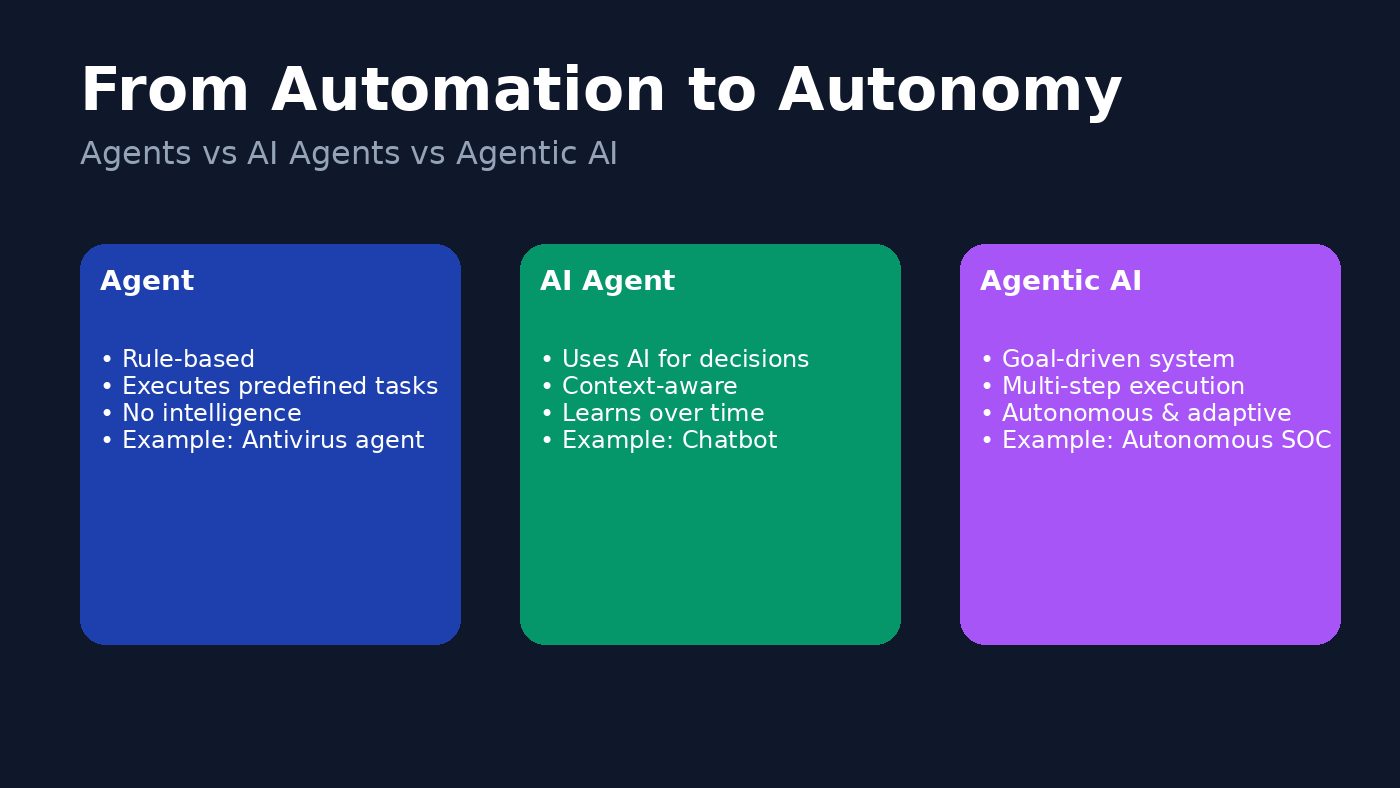
Agent | AI Agent | Agentic AI
But they are not the same. Understanding the difference isn’t just technical—it’s fundamental to how organizations will design systems, teams, and cybersecurity strategies in the coming years.
Let’s break it down in simple terms.
1. Agent (Pre-AI Era in IT)
Meaning
In traditional IT systems, an agent is a software program that performs predefined tasks on behalf of a user or system.
Purpose
To automate repetitive, rule-based operations.
Usage
- Monitoring systems (e.g., server monitoring agents)
- Antivirus agents on endpoints
- Backup agents
- Network management agents
Key Characteristics
- Rule-based
- Deterministic
- No intelligence or decision-making
- Executes only what is pre-programmed
Think of it as: “If X happens, do Y.”
2. AI Agent
Meaning
An AI Agent is a system that uses AI models (like machine learning or LLMs) to perceive, reason, and act toward a defined objective.
Purpose
To enhance decision-making and automate complex tasks that cannot be captured with simple rules.
Usage
- Chatbots and virtual assistants
- Security threat detection systems
- Recommendation engines
- AI copilots (e.g., coding assistants, customer support AI)
Key Characteristics
- Uses data + models for decisions
- Context-aware
- Learns or adapts over time
- Still operates within defined boundaries
Think of it as: “Understand the situation, then decide what to do.”
3. Agentic AI
Meaning
Agentic AI refers to autonomous AI systems that can plan, execute, and adapt multi-step tasks independently—often coordinating multiple tools or agents.
Purpose
To achieve goals end-to-end with minimal human intervention.
Usage
- Autonomous SOC (Security Operations Centers)
- AI-driven DevOps orchestration
- Multi-step business workflows (e.g., lead generation → outreach → follow-up)
- Autonomous research and analysis systems
Key Characteristics
- Goal-driven (not just task-driven)
- Multi-step planning and execution
- Tool usage (APIs, systems, databases)
- Self-correction and iteration
- Can collaborate with other agents
Think of it as: “Given a goal, figure out all the steps, execute them, and improve along the way.”
Side-by-Side Comparison
| Agent | AI Agent | Agentic AI | |
|---|---|---|---|
| Nature | Rule-based | Uses AI for decisions | Goal-driven system |
| Scope | Executes predefined tasks | Context-aware | Multi-step execution |
| Intelligence | No intelligence | Learns over time | Autonomous and adaptive |
| Example | Antivirus agent | Chatbot | Autonomous SOC |
Why This Matters (Especially for Cybersecurity)
We are witnessing a fundamental shift:
- Agents → Automation
- AI Agents → Augmented Intelligence
- Agentic AI → Autonomous Operations
In cybersecurity:
- Traditional agents detect known threats
- AI agents identify unknown patterns
- Agentic AI can detect, investigate, respond, and even remediate—without waiting for humans
This is where the future SOC is heading: From reactive → proactive → autonomous
Final Thought
Organizations don’t need to jump directly to Agentic AI.
The journey is evolutionary:
- Implement strong automation (Agents)
- Layer intelligence (AI Agents)
- Progress toward autonomy (Agentic AI)
The winners in this shift will not just adopt AI—but architect for autonomy.
If you're exploring how Agentic AI will reshape cybersecurity, operations, or enterprise workflows, this is a conversation worth having today—not tomorrow.
Article in collaboration with Microsoft Copilot